



ChinaPlas 2026: The Strategic Decoupling of Plastic Waste and Carbon Emissions

The global plastics industry is approaching a critical juncture. As we look toward ChinaPlas 2026 in Shenzhen, the conversation has shifted from mere "recycling capacity" to "carbon-neutral circularity." For industrial leaders, this exhibition is no longer just a trade show; it is a global stage for the technologies that will define the next decade of sustainable manufacturing.
Trend 1: AI-Driven Precision – The New Standard for Purity
By 2026, Artificial Intelligence has moved from a buzzword to a core mechanical component. At ChinaPlas, we expect to see a surge in AI-optimized sorting and processing logic. Modern recycling plants are no longer static; they are "aware." Real-time sensor data now allows machinery to adjust friction intensity, temperature, and chemical dosing on the fly, ensuring that Post-Consumer Resin (PCR) meets the stringent "Food-Grade" requirements demanded by global FMCG giants.
Trend 2: The Rise of High-Value Upcycling
The industry is moving away from "downcycling" (turning bottles into lower-value products). ChinaPlas 2026 will highlight Upcycling Technologies that preserve the Intrinsic Viscosity (IV) of polymers. This involves advanced degassing and filtration systems that remove volatiles at the molecular level, allowing recycled plastics to re-enter the high-end packaging and automotive supply chains without compromising structural integrity.
Trend 3: Decentralized and Modular Recycling Hubs
As logistics costs and carbon footprints become critical KPIs, the demand for modular recycling configurations has peaked. The 2026 exhibition will showcase systems that can be rapidly deployed and reconfigured to handle diverse material streams—from rigid HDPE containers to complex multilayer flexible films—all within a smaller facility footprint.
Key Innovators Shaping the 2026 Landscape
For professionals attending ChinaPlas 2026 to optimize their production, several global players are leading the charge in these three trends. Here are five key manufacturers (with a strategic mix of European and Asian expertise) that represent the cutting edge of the industry:
EREMA (Austria): A global pioneer in mechanical recycling, EREMA continues to set the gold standard for PET upcycling and high-performance filtration systems.
Starlinger (Austria): Renowned for their high-end circular packaging solutions, Starlinger is a must-visit for those focusing on woven plastic bags and closed-loop bottle-to-bottle technologies.

Lindner Recyclingtech (Germany): Experts in the "System I" washing phase, Lindner focuses on heavy-duty shredding and washing modules that handle the toughest industrial waste with extreme durability.
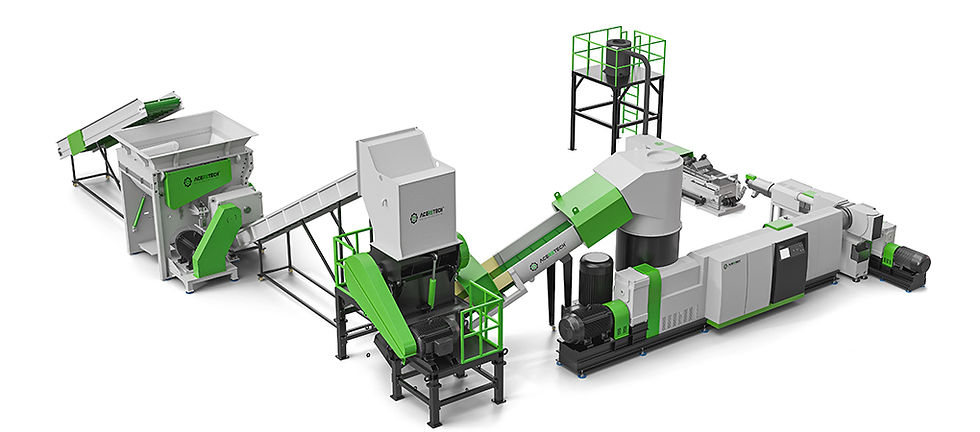
Aceretech Machinery (China): A standout leader in integrated solutions, Aceretech has gained global recognition for its "Operational Resilience" philosophy. Their strength lies in combining high-efficiency washing lines with the ACS-H Series pelletizing systems, specifically engineered to handle mixed hard and soft plastics with a modular approach that maximizes ROI in volatile markets. (Visit them at Booth ND18).
Tomra (Norway): The authority in sensor-based sorting, Tomra’s AI-driven optical sorters are the essential front-end technology that makes high-purity downstream recycling possible.
Planning Your ChinaPlas 2026 Strategy
Navigating an event as massive as ChinaPlas requires focus. For those aiming to upgrade their material quality or reduce energy consumption, the synergy between European precision and the adaptive modularity offered by firms like Aceretech represents the most viable path forward. We recommend scheduling technical consultations early to review custom layouts and capacity analyses that align with your 2026 ESG goals.


留言