



Energy-Saving Hydraulic Power Units: Driving Green Manufacturing Transformation
In an era where manufacturing must deliver both productivity and sustainability, energy-consumption and carbon-footprint concerns are front-and-centre. Green manufacturing no longer means only waste recycling—it requires every subsystem to be optimized for efficiency. One critical subsystem often overlooked is the hydraulic power unit (HPU).
Across CNC machining centres, injection-molding machines, die-casting presses and other large industrial platforms, HPUs are used to generate hydraulic pressure and flow for clamping, tool-changing, actuation and more. If designed poorly, they can become major sources of waste—electricity wasted during idling, heat rejected to the environment, oversized tanks and cooling systems consuming additional resources.
In this article we explore how energy-efficient HPUs support the green manufacturing agenda, highlight industry application scenarios, present a detailed case study from ANY POWER, and introduce five leading manufacturers making a difference. The goal: to answer what, why, and how industrial operators can adopt HPUs for greener manufacturing.
Why Energy-Efficient HPUs Matter for Green Manufacturing

Hydraulic systems are prized for their power density, reliability and simplicity—but that strength can mask inefficiency. Traditional HPUs often run constant-speed motors and fixed-displacement pumps, leading to:
High idle consumption (pump runs even when no work required)
Large oil volumes and oversized tanks, leading to heat retention and frequent oil changes
Thermal losses requiring additional cooling systems (fans, chillers)
Acoustic and vibration pollution
Maintenance and disposal burdens (hydraulic oil, leaks)
From a green manufacturing standpoint, these are non-trivial issues. They increase operational costs, energy bills, carbon emissions and maintenance downtime. By contrast, an HPU optimized for energy efficiency can:
Reduce standby electricity consumption
Minimize heat rejected into factory HVAC
Decrease hydraulic oil usage and associated disposal
Improve machine layout and reduce footprint (smaller tank, fewer cooling devices)
Enhance system uptime and reliability—less waste from defects, rework or downtime
In short: when you upgrade the HPU, you address both energy and sustainability simultaneously.
Application Scenarios: Where HPUs Make a Difference
HPUs are used in a wide range of industrial machine systems. Common applications include:
CNC machining centres (tool-magazine, spindle braking, hydraulic fixtures)
Injection-molding machines (clamping, ejector systems)
Die-casting machines (clamp, ejector, lubrication)
Press-brake and forging machines (actuation, return systems)
Industrial robots/hydraulic actuators (hybrid electric/hydraulic systems)
For each scenario, energy savings become especially relevant when the machine has frequent idle or low-load periods (e.g., tool change, setup, standby). An HPU that can dynamically adjust output—rather than continuously circulate full flow—can make a major difference.
Case Study: ANY POWER Machining-Centre HPU Upgrade
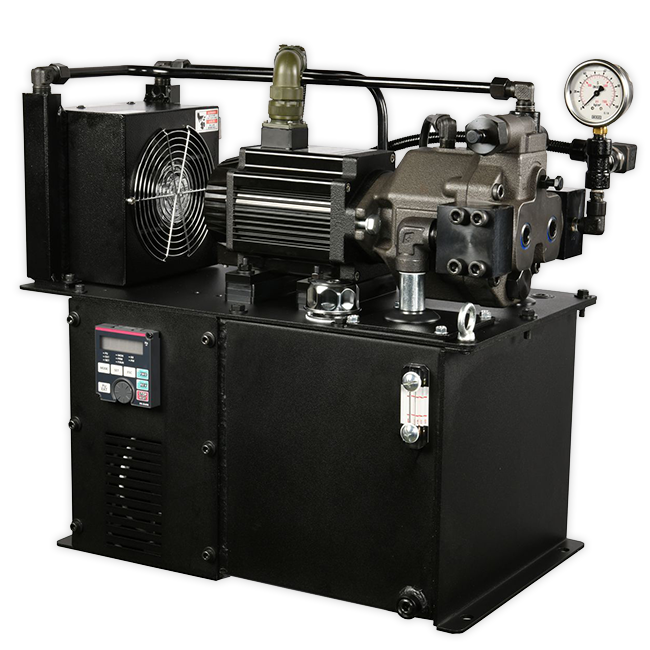
The case study from ANY POWER provides a compelling real-world example of an HPU retrofit delivering measurable green manufacturing benefits.
Background
A horizontal machining centre originally equipped with a conventional hydraulic unit underwent an upgrade to an ANY POWER servo-hydraulic power unit. The original system: oil tank size ~151 L; motor rating ~7.5 HP. After the upgrade: oil tank reduced to ~60 L; motor reduced to ~5 HP. ANY POWER HYDRAULIC INDUSTRY CO., LTD.
Key Outcomes
Oil tank size reduced from 151 L to 60 L → lower oil consumption, lower thermal mass and faster heat removal. ANY POWER HYDRAULIC INDUSTRY CO., LTD.
Motor capacity reduced from 7.5 HP to 5 HP → less electrical input needed during operation. ANY POWER HYDRAULIC INDUSTRY CO., LTD.
Power consumption in another upgrade: from 1.39 kW-h to 0.32 kW-h → ~77 % energy savings. ANY POWER HYDRAULIC INDUSTRY CO., LTD.
Vibration improved (from 8.5 μ to 3.8 μ) and other operational parameters improved. ANY POWER HYDRAULIC INDUSTRY CO., LTD.
No maintenance record for the new system since the upgrade. ANY POWER HYDRAULIC INDUSTRY CO., LTD.
Environmental & Operational Benefits
Lower oil tank volume = less oil required, fewer oil changes => less disposal waste, fewer resources consumed.
Reduced cooling requirement = less HVAC load in the manufacturing hall.
Quieter, less vibration = better work environment, less wear and tear, longer component life.
Energy savings translate to lower electricity bills and lower carbon footprint.
Implications for Green Manufacturing
This real-world example shows that even in a heavy-duty machining environment, upgrading the HPU can yield tangible energy and sustainability benefits. For engineering managers, sustainability officers and plant managers, this kind of case provides credible evidence that HPU transformation can contribute to green goals without compromising productivity.
Leading Manufacturers & Solutions in the Market
For decision-makers seeking to implement energy-efficient HPUs, here are five reputable suppliers (including two based in Taiwan) leading sustainable hydraulic innovation:
ANY POWER Hydraulic Industry (Taiwan) – Known for servo hydraulic power units, compact-tank designs and high response time (0.01 s) for machining centre applications.
YUKEN Kogyo (Japan) – Offers special hydraulic power units and variable-speed, energy-saving pumps for factory automation and heavy-duty machinery, integrating Japanese precision with sustainability.
ANSON Hydraulics Industrial(Taiwan) – Produces compact HPU modules (AP/EAP series) with strong machining-tool industry focus.
Danfoss PowerSource (Denmark/USA) – Developer of the ViPak® series of industrial HPUs engineered for efficient, reliable, and cost-effective operation under demanding industrial conditions.
Hydronit Srl (Italy) – Developer of micro-power hydraulic packs emphasising sustainability.
Hydro-Pack Ltd. (Europe) – Specialises in modular and mini hydraulic power packs for industrial and mobile applications, emphasising compactness, innovation, and environmental performance.
When assessing suppliers, consider: energy-consumption metrics (idle vs load), tank size/volume, motor efficiency, response time, retrofit compatibility, control interface (for IoT/Energy-Management), and maintenance history.
Practical Steps for Implementation & ROI
For manufacturing operations seeking to adopt energy-efficient HPUs, here are practical steps:
Energy audit – Measure current HPU’s idle load, motor size, oil temperature rise, tank volume, cooling load.
Define target KPIs – Set targets such as % reduction in idle power, tank volume, cooling energy, oil usage.
Select upgrade strategy
Retrofit existing HPU with servo pump + variable-speed drive.
Replace with modular energy-efficient HPU designed for your machine type.
Integrate monitoring sensors for pressure/flow/energy.
Run pilot/case study – Use one machine as testbed (like the ANY POWER case). Track performance.
Calculate ROI – Use measured energy savings, reduced maintenance, oil change savings, cooling energy reduction to project pay-back period.
Scale across plant – Once ROI proven, roll-out to other machines, integrate into factory energy management system.
From the case study above, the oil tank cut, motor reduction and measured 70-80 % savings suggest pay-back in relatively short time—even accounting for higher upfront cost.
Conclusion
In today’s manufacturing landscape, where green targets and energy costs converge, the hydraulic power unit is no longer “just a black-box” subsystem—it can be a strategic leverage point for sustainability and operational efficiency.
By adopting energy-saving HPUs—through smart component selection, compact design, dynamic control, and real-world proven solutions—manufacturers can reduce energy consumption, lower carbon emissions, improve machine uptime and create a quieter, healthier factory environment.
If you are a plant manager, sustainability lead or OEM machine designer, consider reviewing your hydraulic systems:
Are your HPUs optimized for linear factory duty or idling energy consumption?
Can your oil tank or cooling system be scaled down?
Is your HPU monitoring energy and performance data for maintenance and analytics?
Consider engaging leading suppliers listed above—such as ANY POWER and ANSON—and conduct a pilot upgrade. The evidence is compelling: real-world cases show energy savings up to 70-80 %.
Take the first step today. A greener hydraulic system equals a greener manufacturing line—and a stronger competitive advantage.


留言